

SUN HYDRAULICS
SEQUENCE CART
SCGALDN
$260.30 USD
Tags:
- SUN HYDRAULICS
- Material:SCGALDN
- Model:SCGA-LDN
- Summary:Cartridge
Quantity in stock: 2
***Disclaimer: The following summary contains information gathered from various sources such as product descriptions, technical specifications and catalogs. While efforts have been made to provide accurate details, inaccuracies may occur. It is advised to verify all information by contacting Sun Hydraulics directly.***
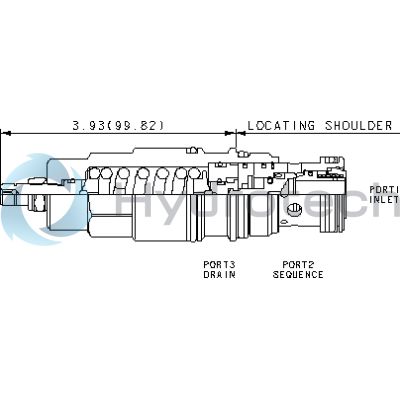
The Sun Hydraulics SCGALDN (SCGALDN) is a direct-acting sequence valve with an integrated reverse flow check, designed to manage secondary circuit flow once the inlet port 1 pressure surpasses the pre-set threshold. This valve is equipped with an integral check valve that facilitates reverse flow from port 2 to port 1. Its pressure setting governs the pressure at port 1 relative to the drain port 3, ensuring that all three port sequence cartridges are interchangeable in terms of flow path and cavity compatibility for a given frame size. Despite being a zero pilot flow valve, it is essential to connect port 3 to maintain a pressure reference in the control chamber; failure to do so may result in malfunction due to reciprocating seal weepage. The pressure at port 3 should not exceed 5000 psi (350 bar), and it directly adds to the valve setting at a 1:1 ratio. This model is suitable for load-holding applications and incorporates Sun's floating style construction, which minimizes internal part binding risks due to excessive installation torque or machining variations. Key specifications include its T-17A cavity, Series 3 classification, and a capacity of up to 60 gpm (240 L/min). The factory pressure settings are established at a flow rate of 2 in\u00b3/min (30 cc/min), with a maximum operating pressure of 5000 psi (350 bar) and typical response time of approximately 2 ms. The valve's maximum leakage at reseat is limited to 10 drops/min (0.7 cc/min), with a check cracking pressure of 25 psi (1.7 bar). Adjustments can be made by turning clockwise up to five full turns, with specific torque requirements for installation and locknut adjustments provided for optimal performance.
The Sun Hydraulics SCGALDN (SCGALDN) is a direct-acting sequence valve with an integrated reverse flow check, designed to manage secondary circuit flow once the inlet port 1 pressure surpasses the pre-set threshold. This valve is equipped with an integral check valve that facilitates reverse flow from port 2 to port 1. Its pressure setting governs the pressure at port 1 relative to the drain port 3, ensuring that all three port sequence cartridges are interchangeable in terms of flow path and cavity compatibility for a given frame size. Despite being a zero pilot flow valve, it is essential to connect port 3 to maintain a pressure reference in the control chamber; failure to do so may result in malfunction due to reciprocating seal weepage. The pressure at port 3 should not exceed 5000 psi (350 bar), and it directly adds to the valve setting at a 1:1 ratio. This model is suitable for load-holding applications and incorporates Sun's floating style construction, which minimizes internal part binding risks due to excessive installation torque or machining variations. Key specifications include its T-17A cavity, Series 3 classification, and a capacity of up to 60 gpm (240 L/min). The factory pressure settings are established at a flow rate of 2 in\u00b3/min (30 cc/min), with a maximum operating pressure of 5000 psi (350 bar) and typical response time of approximately 2 ms. The valve's maximum leakage at reseat is limited to 10 drops/min (0.7 cc/min), with a check cracking pressure of 25 psi (1.7 bar). Adjustments can be made by turning clockwise up to five full turns, with specific torque requirements for installation and locknut adjustments provided for optimal performance.
Direct-acting sequence valves with reverse-flow check will supply a secondary circuit with flow once the pressure at the inlet (port 1) has exceeded the valve setting. Additionally, these valves incorporate an integral check valve to provide reverse flow from port 2 (sequence) to port 1 (inlet). The pressure setting of a sequence valve controls the pressure at port 1 relative to the pressure at the drain (port 3).
- All 3 port sequence cartridges are physically and functionally interchangeable (i.e. same flow path, same cavity for a given frame size).
- Although this is a zero pilot flow valve, port 3 (drain) must be connected to maintain a pressure reference in the control chamber. If port 3 is blocked, reciprocating seal weepage will cause the valve to malfunction.
- Pressure at port 3 is directly additive to the valve setting at a 1:1 ratio and should not exceed 5000 psi (350 bar).
- Suitable for use in load holding applications.
- Incorporates the Sun floating style construction to minimize the possibility of internal parts binding due to excessive installation torque and/or cavity/cartridge machining variations.
| Cavity | T-17A |
| Series | 3 |
| Capacity | 60 gpm240 L/min. |
| Factory Pressure Settings Established at | 2 in³/min.30 cc/min. |
| Maximum Operating Pressure | 5000 psi350 bar |
| Response Time - Typical | 2 ms2 ms |
| Maximum Valve Leakage at Reseat | 10 drops/min.0,7 cc/min. |
| Check Cracking Pressure | 25 psi1,7 bar |
| Adjustment - Number of Clockwise Turns to Increase Setting | 55 |
| Valve Hex Size | 1 1/4 in.31,8 mm |
| Valve Installation Torque | 150 - 160 lbf ft203 - 217 Nm |
| Adjustment Screw Internal Hex Size | 5/32 in.4 mm |
| Locknut Hex Size | 9/16 in.15 mm |
| Locknut Torque | 80 - 90 lbf in.9 - 10 Nm |
| Model Weight | 1.50 lb0,70 kg |
| Seal kit - Cartridge | Viton: 990-017-006 |
Show FAQ
Additional Resources
- Sun Offers Zinc-Nickel Plating for Corrosion Resistance
- Sun Cartridges with EPDM Seals
- Sun Expands Corrosion-Resistant Solutions
- QuickDesign with SmartConnect Offers Drag-and-Drop Schematic Tool
- Series 4 PLUS Cartridges Offer Higher Flows with Lower Pressure Losses
- Sequence Valves Technical Tips
- Manufacturing Sun Cartridge Cavities
- Sequence Valves
- Sun Model Code Explanation; 999-901-334
- Cavity Information (S-171) and Tooling
- Cartridges: Materials of Construction
- Fluid and Temperature Recommendations
- Performance Data
- Sun's Floating Style Screw-In Cartridge
- Units of Measure, Settings, and Conversions