

SUN HYDRAULICS
PSDPMDN924N
$254.40 USD
Tags:
- SUN HYDRAULICS
- Material:PSDPMDN924N
- Model:PSDP-MDN@924N
- Summary:Cartridge
Quantity in stock: 0
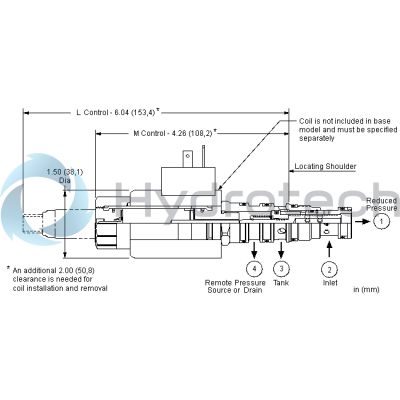
The Sun Hydraulics PSDPMDN924N (PSDPMDN924N) is an electroproportional, direct-acting reducer-reliever valve designed to manage high primary pressure at inlet port 2 and maintain a consistent reduced pressure at port 1, while also offering a full flow relief function from port 1 to tank port 3. This valve is initially set to the relieving mode, and energizing the coil facilitates the connection between port 2 and port 1. The reduced pressure at port 1 increases proportionally with increased current to the coil. If the pressure surpasses the coil-induced setting, it is relieved to port 3. The valve's design minimizes oil consumption during transitions between reducing and relieving modes. It features optional manual control for emergency settings or pressure boosting during power failures. This valve is optimal for accumulator circuits due to its low leakage in secondary circuits, which is beneficial in contaminated systems or dead-headed conditions. It can handle a maximum operating pressure of up to 5000 psi (350 bar) and has a capacity of up to 5 gpm (20 L/min). Port 3 should be limited to a maximum pressure of 3000 psi (210 bar). The design includes Sun's floating style construction, reducing the risk of internal part binding due to installation torque or machining variations. For best performance, an amplifier with adjustable dither between 100-250 Hz is recommended. The valve allows reverse flow from reduced pressure port 1 to inlet port 2; however, this may cause the main spool to close unless a separate check valve is added for free flow requirements. Adjustments can be made using an 'L' manual screw adjustment feature for precise control over settings even when de-energized.
This electro-proportional, direct-acting reducer/reliever valve reduces a high primary pressure at the inlet (port 2) to a constant reduced pressure at port 1, with a full flow relief function from port 1 to tank (port 3). The valve is biased to the relieving mode. Energizing the coil connects port 2 to port 1. Increasing the current to the coil will proportionally increase the reduced pressure at port 1. If pressure at port 1 exceeds the setting induced by the coil, pressure at port 1 is relieved to port 3. Draining port 4 makes the valve insensitive to pressure at port 3. This valve is closed in the transition between reducing and relieving resulting in very low consumption of oil. Optional full manual control is available.
- Maximum pressure at port 3 should be limited to 3000 psi (210 bar).
- All spring ranges are tested for correct operation with 5000 psi (350 bar) inlet pressure.
- Suitable for accumulator circuits since the absence of pilot control flow results in reduced secondary circuit leakage.
- Direct acting concept provides highly reliable operation in contaminated systems, especially at dead headed conditions.
- Leakage specified in Technical Data is out of port 3 with a supply pressure of 2000 psi (140 bar) and the valve set at mid range. This leakage is directly proportional to pressure differential and inversely proportional to viscosity expressed in centistokes.
- The transition from reducing to relieving is closed. The result is very low leakage. However, there is a transitional step increase in pressure between reducing and relieving modes. This step equals about 5% of the high end of the adjustment range, independent of the valve setting.
- For optimum performance, an amplifier with current sensing and adjustable dither should be used. Dither should be adjustable between 100 - 250 Hz.
- Full reverse flow from reduced pressure (port 1) to inlet (port 2) may cause the main spool to close. If reverse free flow is required in the circuit, consider adding a separate check valve to the circuit.
- Uses for the 'L' manual screw adjustment include: emergency valve setting during power failure or alternatively boosting the valve setting
- With the 'L' adjustment screw, all ranges are factory set at zero (adjustment screw fully backed out). With the coil de-energized, clockwise adjustment of the screw will increase the spring bias load up to the maximum setting for that range. With the coil energized, any mechanical pressure setting is directly additive to the coil induced value.
- By controlling the pressure at the drain (port 4), the effective setting of the valve can be increased over the nominal valve setting.
- Pressure on the drain (port 4) is directly additive to the valve setting at a 1:1 ratio and should not exceed 3000 psi (210 bar).
- Incorporates the Sun floating style construction to minimize the possibility of internal parts binding due to excessive installation torque and/or cavity/cartridge machining variations.
| Cavity | T-21A |
| Series | 1 |
| Capacity | 5 gpm20 L/min. |
| Maximum Operating Pressure | 5000 psi350 bar |
| Maximum Valve Leakage at 110 SUS (24 cSt) | 2.5 in³/min.41 cc/min. |
| Optimum Inlet Pressure | 3000 psi210 bar |
| Adjustment - Number of Clockwise Turns to Increase Setting | 55 |
| Solenoid Tube Diameter | .75 in.19 mm |
| Valve Hex Size | 7/8 in.22,2 mm |
| Valve Installation Torque | 30 - 35 lbf ft41 - 47 Nm |
| Adjustment Screw Internal Hex Size | 5/32 in.4 mm |
| Locknut Hex Size | 9/16 in.15 mm |
| Locknut Torque | 80 - 90 lbf in.9 - 10 Nm |
| Model Weight (with coil) | 1.20 lb0,55 kg |
| Seal kit - Cartridge | Viton: 990-021-006 |
| Seal and nut kit - Coil | Viton: 990-770-006Viton: 990-770-006 |
Show FAQ
Additional Resources
- Weatherized Solenoid Valves for Harsh Environments
- Configure Your Bluetooth Embedded Amplifier with AmpSet Blue™
- Series 4 PLUS Cartridges Offer Higher Flows with Lower Pressure Losses
- QuickDesign with SmartConnect Offers Drag-and-Drop Schematic Tool
- Electro-Proportional Basics Explained
- Sun Offers Zinc-Nickel Plating for Corrosion Resistance
- Sun Expands Corrosion-Resistant Solutions
- Sun Cartridges with EPDM Seals
- Solenoid Coils for Switching and Proportional Valves
- Reducing and Reducing/Relieving Valves
- Proportional Amplifiers and Ancillary Products
- Manufacturing Sun Cartridge Cavities
- Electro-Proportional Cartridge Valves
- Sun's Floating Style Screw-In Cartridge
- Fluid and Temperature Recommendations
- Sun Model Code Explanation; 999-901-334
- Performance Data
- Cartridges: Materials of Construction
- Units of Measure, Settings, and Conversions
- Electro-Proportional Terms and Definitions
- Cavity Information (S-171) and Tooling
Notes:
- Please verify cartridge clearance requirements when choosing a Sun manifold. Different valve controls and coils require different clearances.