

BOSCH REXROTH
R900490630
$2,331.50 USD
- BOSCH REXROTH
- Material:R900490630
- Model:PR4-1X/100-450WA01M01 GO2
Quantity in stock: 0
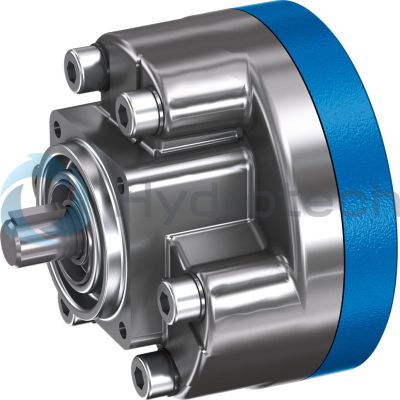
The Bosch Rexroth PR4-1X/100-450WA01M01 (R900490630) is a high-quality radial piston pump designed for industrial open-circuit applications. This pump features a constant displacement and is known for its durability and long service life, thanks to its hydrodynamic plain bearings. It operates effectively with a maximum pressure and offers a displacement size of . ccm. The PR4-1X/100-450WA01M01 is selfpriming and utilizes valve control to manage fluid flow efficiently. With bidirectional rotation capability, the pump can be integrated seamlessly into various system configurations. Its compact design allows for space-saving installation, making it ideal for environments where space is at a premium. The pump's speed ranges from a minimum to a maximum, supporting an optimal max flow rate that ensures reliable performance under various operating conditions. Bosch Rexroth has engineered this pump with NBR seals, ensuring compatibility with HLP hydraulic fluids. It also features bolt face mounting for secure attachment and easy assembly within your system. The connection diagram provided ensures straightforward setup, while the absence of throughdrive contributes to the unit's compactness. This radial piston pump stands out for its combination possibilities, allowing it to be used alongside constant and variable vane pumps. Available in five different sizes, the PR4-1X/100-450WA01M01 offers versatility to meet diverse application needs while maintaining consistent performance across its range. Whether you require dependable fluid power delivery or precise control within your industrial application, the Bosch Rexroth PR4-1X/100-450WA01M01 radial piston pump delivers robust functionality in a durable package.
Radial piston pump, size 1.0 ccm, pressure 450 bar for industrial applications, open circuit
Small 3-piston pump, self-priming, with valve control. Long service life thanks to hydrodynamic plain bearing
Unpacked Weight: 1.98 kg
Assembly
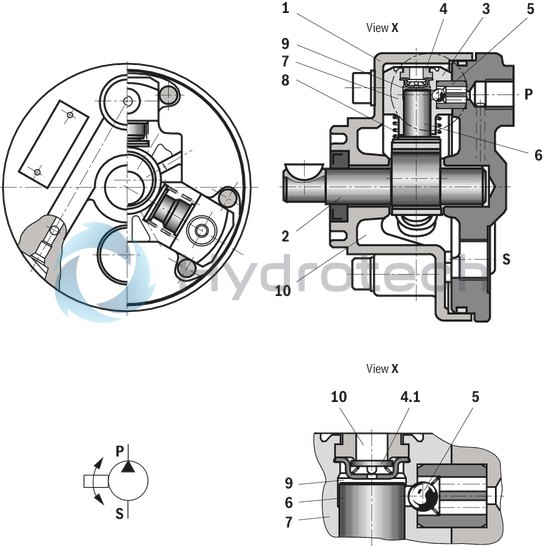
The pumps are valve-controlled, self-priming radial piston pumps with fixed displacement.
They consist essentially of the housing (1), eccentric shaft (2) and pump elements (3), with suction valve (4), pressure valve (5) and piston (6).
Suction and displacement process
Pistons (6) are arranged radially to the eccentric shaft (2). The piston (6) is guided in cylinder (7) and pressed against the eccentric (2) by the spring (8). During the downward movement of piston (6), the working chamber (9) in the cylinder (7) increases in size. The resulting negative pressure lifts the suction valve plate (4.1) from the sealing edge. This opens the connection from the suction chamber (10) to the working chamber (9). The working chamber fills with fluid. During the upward movement of piston (6), the suction valve closes and the pressure valve (5) opens. Fluid can now flow to the system via pressure port (P).
| Data Sheet | Download Data Sheet |
| 3D CAD | Download 3D CAD |
| Max. pressure | 450 |
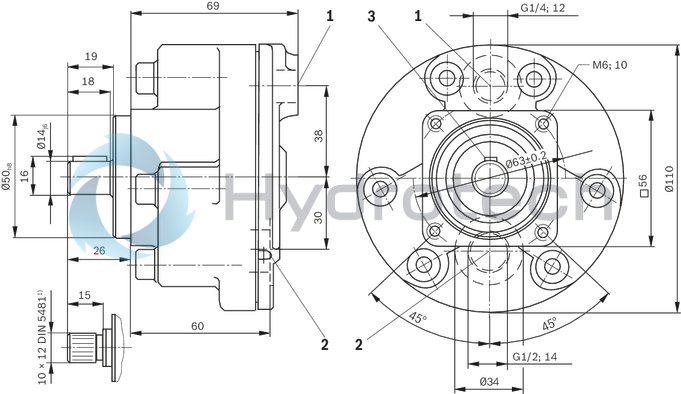
| Shaft end | Cylindrical Ø 14 mm with fitting key |
| Size | 1 |
| Speed min. | 1000 |
| Productgroup ID | 9,10,11,12,13,14 |
| Speed max. | 2000 |
| Fastening | 4-hole fastening centering 50 mm |
| Max. flow | 2 |
| Displacement type | constant |
| Direction of rotation | counterclockwise and clockwise rotation |
| Connection diagram | 1 |
| Through-drive | without |
| Weight | 1.98 |
| Seals | NBR |
| Hydraulic fluid | HLP |
|
01 |
02 |
03 |
04 |
05 |
06 |
07 |
08 |
09 |
||
|
PR4 |
– |
1X |
/ |
W |
01 |
* |
|
Type |
||||
|
01 |
Radial piston pump, fixed displacement, maximum pressure 700 bar |
PR4 |
||
|
Component series |
||||
|
02 |
Component series 10 ... 19 (10 ... 19: unchanged installation and connection dimensions) |
1X |
||
|
Size |
NG |
Pressure rating |
|
|
|
03 |
Size – pressure stage (maximum) |
0,40 |
700 bar |
0,40-700 |
|
0,63 |
700 bar |
0,63-700 |
||
|
1,00 |
450 bar |
1,00-450 |
||
|
1,60 |
250 bar |
1,60-250 |
||
|
2,00 |
175 bar |
2,00-175 |
||
|
Direction of rotation |
||||
|
04 |
Viewed on drive shaft |
clockwise and counter-clockwise |
W |
|
|
Drive shaft |
||||
|
05 |
Parallel keyed shaft |
A |
||
|
Splined shaft 10 x 12, DIN 5481 (for combination with vane pumps) |
G |
|||
|
Line connection |
||||
|
06 |
Pipe thread according to ISO 228/1 |
01 |
||
|
Seal material |
||||
|
07 |
NBR seals |
M |
||
|
FKM seals |
V |
|||
|
Pressure ports |
||||
|
08 |
1 Pressure port |
01 |
||
|
3 Pressure ports |
03 |
|||
|
Additional details |
||||
|
09 |
Further details in the plain text |
* |
||


|
Size |
0,40 | 0,63 | 1,00 | 1,60 | 2,00 | |||||
|
Displacement |
geometric |
Vg |
cm³ |
0.4 | 0.63 | 1 | 1.6 | 2 | ||
|
Drive speed |
nmin |
rpm |
1000 | 1000 | 1000 | 1000 | 1000 | |||
|
nmax |
rpm |
3400 | 3000 | 2000 | 2000 | 2000 | ||||
|
Operating pressure |
absolute |
Inlet |
p |
bar |
0.8 ... 1.5 | 0.8 ... 1.5 | 0.8 ... 1.5 | 0.8 ... 1.5 | 0.8 ... 1.5 | |
|
Outlet |
continuous |
pN |
bar |
700 | 700 | 450 | 250 | 175 | ||
|
Torque |
max. |
Drive shaft |
Nm |
10 | 10 | 10 | 10 | 10 | ||
|
Weight |
m |
kg |
2.6 | 2.6 | 2.6 | 2.6 | 2.6 | |||
|
Drive shaft loading |
Radial and axial forces cannot be absorbed! | Radial and axial forces cannot be absorbed! | Radial and axial forces cannot be absorbed! | Radial and axial forces cannot be absorbed! | Radial and axial forces cannot be absorbed! | |||||
|
Mounting type |
Front face mounting | Front face mounting | Front face mounting | Front face mounting | Front face mounting | |||||
|
Line connections |
Screw-in fittings | Screw-in fittings | Screw-in fittings | Screw-in fittings | Screw-in fittings | |||||
|
Direction of rotation, viewed on drive shaft |
Counter-clockwise or clockwise, has no influence on the flow direction | Counter-clockwise or clockwise, has no influence on the flow direction | Counter-clockwise or clockwise, has no influence on the flow direction | Counter-clockwise or clockwise, has no influence on the flow direction | Counter-clockwise or clockwise, has no influence on the flow direction | |||||
|
Hydraulic fluid |
||||||||||
|
Permissible hydraulic fluid 1) |
Mineral oil (HLP) to DIN 51524-2 | |||||||||
|
Operating temperature range |
°C |
-10 … +70 | ||||||||
|
Viscosity range |
mm²/s |
10 … 200 | ||||||||
|
Maximum admissible degree of contamination of the hydraulic fluid 1) |
Class 20/18/15 according to ISO 4406 (c) | |||||||||
| 1) | The cleanliness classes specified for the components must be adhered to in hydraulic systems. Effective filtration prevents faults and simultaneously increases the life cycle of the components. For the selection of the filters, see www.boschrexroth.com/filter. |
|
Flow/drive power 1) |
||||||||||||||||||
|
NG |
pmax bar |
Vg cm3 |
Pressure |
bar |
50 |
100 |
150 |
200 |
250 |
300 |
350 |
400 |
450 |
500 |
550 |
600 |
650 |
700 |
|
0,40 |
700 |
0.40 |
qV, eff |
l/min |
0.55 |
0.54 |
0.54 |
0.53 |
0.53 |
0.52 |
0.51 |
0.50 |
0.50 |
0.49 |
0.49 |
0.48 |
0.48 |
0.47 |
|
PA |
kW |
0.07 |
0.12 |
0.16 |
0.20 |
0.25 |
0.30 |
0.34 |
0.39 |
0.43 |
0.48 |
0.52 |
0.57 |
0.61 |
0.66 |
|||
|
0,63 |
700 |
0.63 |
qV, eff |
l/min |
0.95 |
0.94 |
0.93 |
0.92 |
0.91 |
0.90 |
0.89 |
0.88 |
0.88 |
0.87 |
0.86 |
0.85 |
0.84 |
0.83 |
|
PA |
kW |
0.10 |
0.18 |
0.26 |
0.34 |
0.42 |
0.51 |
0.58 |
0.67 |
0.74 |
0.82 |
0.90 |
0.98 |
1.07 |
1.15 |
|||
|
1,00 |
450 |
1.00 |
qV, eff |
l/min |
1.47 |
1.45 |
1.43 |
1.41 |
1.40 |
1.39 |
1.38 |
1.37 |
1.36 |
– |
– |
– |
– |
– |
|
PA |
kW |
0.16 |
0.28 |
0.41 |
0.53 |
0.66 |
0.77 |
0.89 |
1.02 |
1.14 |
– |
– |
– |
– |
– |
|||
|
1,60 |
250 |
1.60 |
qV, eff |
l/min |
2.35 |
2.35 |
2.34 |
2.33 |
2.33 |
– |
– |
– |
– |
– |
– |
– |
– |
– |
|
PA |
kW |
0.22 |
0.43 |
0.64 |
0.85 |
1.06 |
– |
– |
– |
– |
– |
– |
– |
– |
– |
|||
|
2,00 |
175 |
2.00 |
qV, eff |
l/min |
2.98 |
2.97 |
2.96 |
– |
– |
– |
– |
– |
– |
– |
– |
– |
– |
– |
|
PA |
kW |
0.31 |
0.58 |
0.86 |
– |
– |
– |
– |
– |
– |
– |
– |
– |
– |
– |
|||
| 1) | Mean values measured at n = 1450 rpm, Θ = 50 °C |
For pumps with 3 pressure ports, type “03“ applies the following:
Using various operating pressures for each cylinder the drive power of the highest cylinder pressure is to be selected.
▼ Example: Pump PR4–1X/0.63–700...03
Ports 1 and 2, respectively loaded with 450 bar, 3 is circulating at zero pressure.
PA = 0.74 kW
For applications outside these parameters, please consult us!
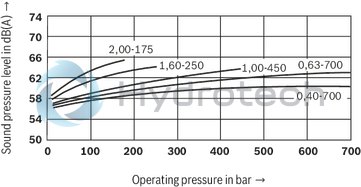
Sound pressure level
|
Note |
|
|
• |
Characteristic curves are mean values, measured at n = 1450 rpm; ν = 41 mm²/s, θ = 50 °C |
|
• |
Sound pressure level measured in acoustic room according to DIN 45635, part 26 |
|
• |
Distance: Microphone – pump = 1 m |
|
• |
At a system pressure below 4 bar and a viscosity > 150 mm²/s audible valve noise may occur |
|
• |
Sound pressure level at system pressure < 4 bar: ≤ 58 dB(A) |
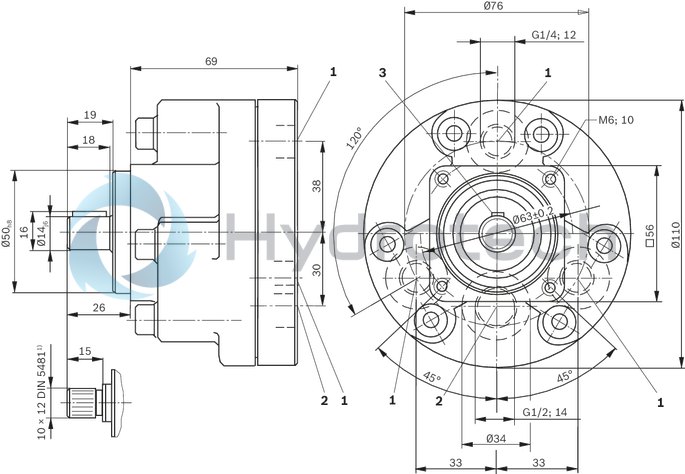
Installation instructions
Fluid tank
Adjust useful volume of the tank to the operating conditions. The admissible fluid temperature must not be exceeded; use coolers, if necessary.
Lines and ports
Remove protection plugs from the pump. We recommend the use of seamless precision steel pipes according to DIN EN 10305-1 and removable pipe connections. Select the clear width of pipes according to the ports (suction speed 1 to 1.5 m/s). Inlet pressure, see technical data. Thoroughly clean pipelines and fittings prior to installing.Proposal for piping layout
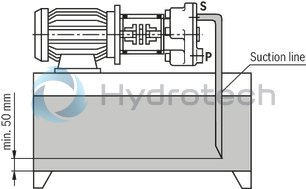 Under no circumstances may drain and returning fluid be drawn directly into the suction port again, i.e., select the largest possible distance between suction line and return line. The return drain must always be below the oil level. Ensure suction-tight installation of the pipes.
Filter
Use a return flow or pressure filter, if possible.
(Suction filters only in connection with underpressure switch/clogging indicator).
Hydraulic fluid
Please observe our specifications according to data sheet 90220. We recommend brand name hydraulic fluids. Do not mix hydraulic fluids of different types since this can result in decomposition and deterioration of the lubricity. The hydraulic fluid must be replaced at regular intervals according to the operating conditions. When doing this, the hydraulic fluid reservoir must also be cleaned of residues.
Drive
Electric motor + pump carrier + coupling + pump
 No radial or axial forces permissible on the pump drive shaft! Motor and pump must be exactly aligned! Always use a coupling that is suitable for compensating for shaft offsets! When installing the coupling, avoid axial forces, i.e., when installing, do not hammer or press the coupling onto the shaft! Use the female thread on the drive shaft.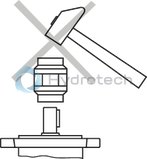
Installation positions
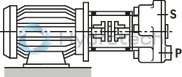
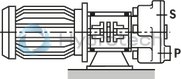
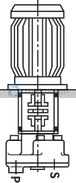
Horizontal installation (B3, B5): Always position the suction port over the pressure port. This arrangement supports bleeding of the pump. Vertical installation (V1): No restrictionsB3
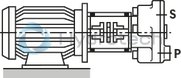
B5
V1
Project planning information
When using radial piston pumps, we recommend particularly observing the information specified below. Project planning, assembly and commissioning of the radial piston pumps require the employment of trained experts.
Technical data
All specified characteristic depend on production tolerances and are valid at certain boundary conditions. Please note that consequently, certain scatter ranges are possible and that with changed boundary conditions (e.g. viscosity), the characteristics may also change.
Characteristic curves for flow and consumed power
When designing the drive motor, please observe the maximum application parameters possible.
Noise
The values for sound pressure level shown under Diagrams/characteristic curves have been measured according to DIN 45635 part 26. That means only the sound emission of the pump is shown. Environmental influences (such as place of installation, piping, etc.) have been eliminated. The values are in each case only valid for one pump. For circulation at zero pressure, the pressure line must be preloaded by means of a check valve (cracking pressure p = 5 bar) due to noise development.
Notice
Due to the power unit construction and the influence at the final place of installation of the pump, the sound pressure level will usually be 5 to 10 dB(A) higher than the value of the pump itself.
Commissioning instructions
Air bleeding
All PR4 radial piston pumps are self-priming. Fill the housing with filtered oil via port S. During initial commissioning, set the pump to pressureless circulation. To do so, release the pressure hose and direct it into the reservoir. Before initial commissioning, the pump must be air-bled to protect it against damage. Switch to pressureless circulation, or direct the pressure line or pressure hose back into the reservoir. Briefly switch the pump on (inching mode). Should the pump not displace bubble-free oil after approx. 20 seconds, re-check the system. After the operating values have been reached, check the pipe connections for leakage. Check the operating temperature. Be aware of noise generation.
Commissioning
Check whether the system is thoroughly and properly installed. Start the pump without load and let it displace fluid without pressure for a few seconds in order to ensure sufficient lubrication. In no case may the pump be operated without hydraulic fluid!
Note
Adjustment, maintenance and repair of the pump may only be carried out by authorized, trained and instructed personnel! Use only original Rexroth spare parts! The pump may only be operated within the permissible data. The pump may only be operated when in perfect condition! When carrying out any work on the pump (e.g. installation and removal) the system must be switched off and depressurized! Unauthorized conversions and changes, affecting the safety and function are not permissible! Mount protective devices (e.g., coupling protection)! Do not remove any existing protective devices! The generally valid safety and accident prevention regulations must be strictly observed!